What Is Blood?
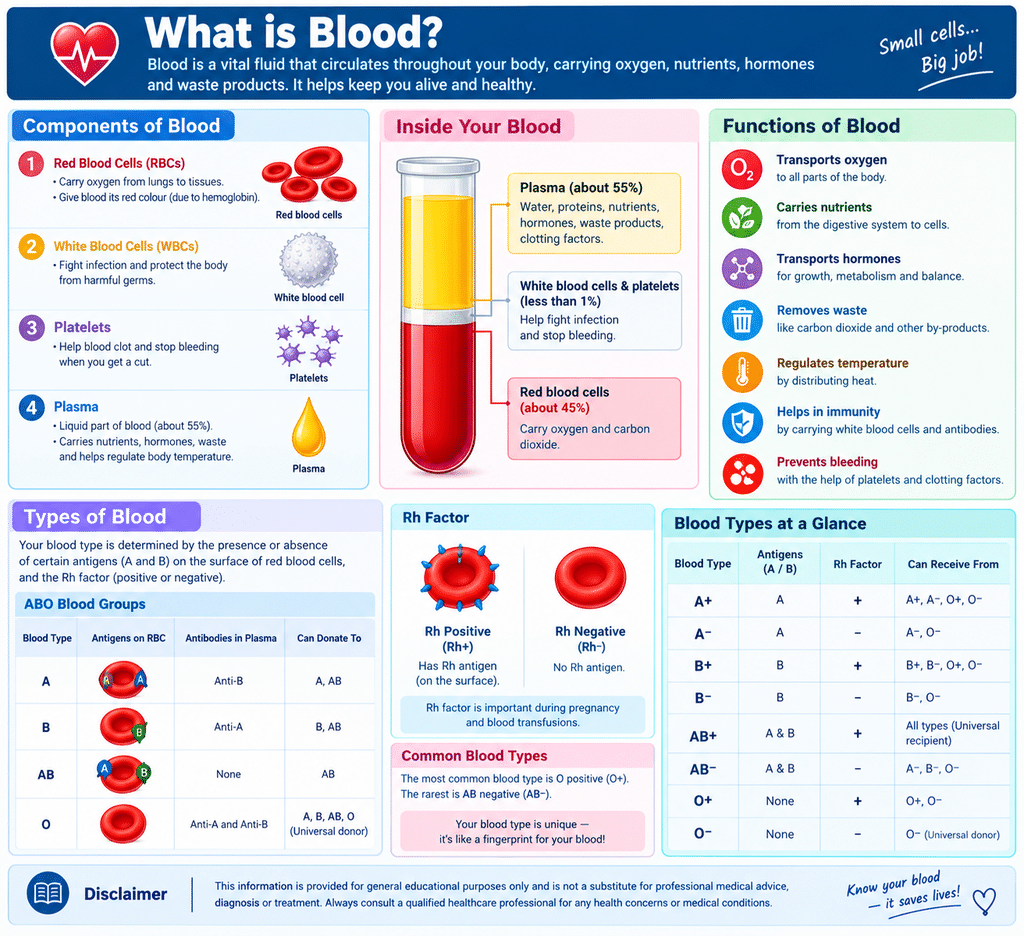
Blood is a specialized fluid connective tissue that circulates throughout the body through blood vessels. It transports oxygen, nutrients, and hormones, removes waste products, fights infections, and helps control body temperature.
1. Main components of blood

1. Red Blood Cells (RBCs)
Carry oxygen from the lungs to body tissues using haemoglobin, the protein that gives blood its red colour.

2. White Blood Cells (WBCs)
Help protect the body against infections and other harmful organisms.

3. Platelets
Help blood clot and stop bleeding when a blood vessel is injured.

4. Plasma
The liquid portion of blood, consisting mainly of water, that transports proteins, nutrients, hormones, and waste products.
2. Types of blood groups
Blood groups are classified mainly using the ABO system and the Rh factor.


ABO blood group system
| Blood group | Antigens on red blood cells |
|---|---|
| A | A antigen |
| B | B antigen |
| AB | Both A and B antigens |
| O | Neither A nor B antigen |
Rh factor
- Rh-positive (+): The D antigen is present on red blood cells.
- Rh-negative (−): The D antigen is absent.
Combining these systems gives eight common blood types: A+, A−, B+, B−, AB+, AB−, O+, and O−.
3. Blood donation and compatibility
For red blood cell transfusions, the following general rules apply:
- O negative (O−): Often called the universal red blood cell donor.
- AB positive (AB+): Often called the universal red blood cell recipient.
- Other blood groups have specific compatibility requirements.
Blood group compatibility alone is not enough to approve a transfusion; laboratory testing and crossmatching are essential.
Disclaimer
This information is intended for general educational purposes only. Blood group compatibility can vary by transfusion context, and this explanation does not replace professional medical advice or laboratory testing. Always consult qualified healthcare professionals for blood donation, transfusion, or medical concerns.